

Skip to Content Skip to Footer
West Virgins WIC logo
West Virgina Wic logo
  • Home
  • Ellyn Satter
    • Ellyn Satter
      Prenatal / Postpartum
    • Ellyn Satter
      Newborn / Infant
    • Ellyn Satter
      Older Baby / Almost Toddler
    • Ellyn Satter
      Toddler / Preschooler
  • Eat. Grow. Live Healthy
    • Eat. Grow. Live Healthy
      Women
    • Eat. Grow. Live Healthy
      Infants
    • Eat. Grow. Live Healthy
      Children
    • Eat. Grow. Live Healthy
      Fathers
  • Español

Understand your preschooler

  • Home
  • Ellyn Satter
  • Toddler / Preschooler
  • Preschooler
  • Understand your preschooler
Boy Happy

How has your child changed from when he was younger?

What do you like about this age?

What don’t you like?

Your preschooler needs both trust and guidance.

He can be on his own for short times. He does what you want. He can keep out of trouble. But he is still a child and needs you to show him how to behave. He wants to be like you. He eats better when he is with you or with another grownup he depends on.

Here is what your preschooler is like:

Girl Strawberries
  • He wants to get better at all that he does–including eating. He learns in little steps. He works to like new foods, learn table manners, and eat in other places besides home.
  • He thinks you know everything, and he needs you to show him what he needs to learn. Show him by deciding what, when, and where he gets to eat.
  • He wants to please you. Make it possible by letting him decide how much and whether to eat—of what you offer. He eats if you make him, but he feels bad.
  • He likes serving himself at meals. He doesn’t always eat everything he takes. Teach him to dish up less and ask for more helpings.
  • He needs to know you approve. Pay attention when he does things right, not just when he does things wrong.

© Ellyn Satter

West Virginia WIC Program logo

Contact Us

350 Capitol Street, Room 515
Charleston, WV 25301
304-558-0030
dhhr.wv.gov/wic

Learn More

  • How to Apply
  • Find a Clinic
  • Where can I shop?

Resources

  • West Virginia Medicaid
  • Nutrition and Breastfeeding Resources
  • West Virginia Division of Tobacco Prevention
  • West Virginia 211
  • Facebook
  • WIC West Virginia Twitter Logo. Learn more about WIC.

USDA is an equal opportunity provider, employer, and lender.

Cookie PolicyPrivacy Policy

© Brush Art Corporation

×
  • Email
  • SMS
If you are using multiple emails, separate them with commas.

    SMS Communication Consent

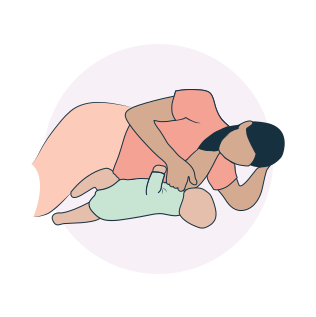
    Side-Lying Hold

    1. For the right breast, lie on your right side with your baby facing you.
    2. Pull your baby close. Your baby’s mouth should be level with your nipple.
    3. In this position, you can cradle your baby’s back with your left arm and support yourself with your right arm and/or pillows.
    4. Keep loose clothing and bedding away from your baby.
    5. Reverse for the left breast.

    This hold is useful when:

    • You had a C-section
    • You want to rest while baby feeds
    • You are breastfeeding in the middle of the night
    • You and your baby are comfortable in this position

    Cross-Cradle Hold

    1. For the right breast, use your left arm to hold your baby’s head at your right breast and baby’s body toward your left side. A pillow across your lap can help support your left arm.
    2. Gently place your left hand behind your baby’s ears and neck, with your thumb and index finger behind each ear and your palm between baby’s shoulder blades. Turn your baby’s body toward yours so your tummies are touching.
    3. Hold your breast as if you are squeezing a sandwich. To protect your back, avoid leaning down to your baby. Instead, bring your baby to you.
    4. As your baby’s mouth opens, push gently with your left palm on baby’s head to help them latch on. Make sure you keep your fingers out of the way.
    5. Reverse for the left breast.

    This hold is useful when:

    • Your baby is premature
    • Your baby has a weak suck
    • Your baby needs help to stay latched
    • Your baby needs extra head support
    • You and your baby are comfortable in this position

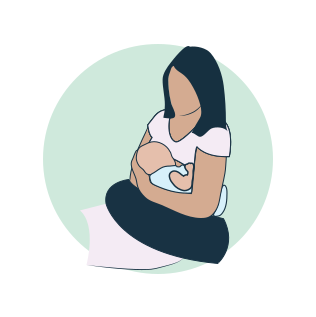
    Clutch or “Football” Hold

    1. For the right breast, hold your baby level, facing up, at your right side.
    2. Put your baby’s head near your right nipple and support their back and legs under your right arm.
    3. Hold the base of your baby’s head with your right palm. A pillow underneath your right arm can help support your baby’s weight.
    4. To protect your back, avoid leaning down to your baby. Bring baby to you instead.
    5. Reverse for the left breast.

    This hold is useful when:

    • You had a C-section
    • You have large breasts
    • You have flat or inverted nipples
    • You have a strong milk let-down
    • You are breastfeeding twins
    • Your baby likes to feed in an upright position
    • Your baby has reflux
    • You and your baby are comfortable in this position

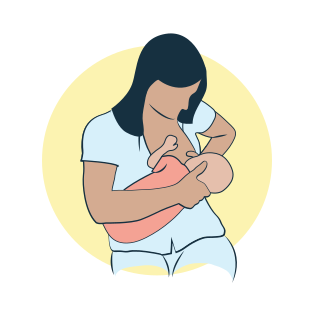
    Cradle Hold

    1. For the right breast, cradle your baby with your right arm. Your baby will be on their left side across your lap, facing you at nipple level.
    2. Your baby’s head will rest on your right forearm with your baby’s back along your inner arm and palm.
    3. Turn your baby’s tummy toward your tummy. Your left hand is free to support your breast, if needed. Pillows can help support your arm and elbow.
    4. To protect your back, avoid leaning down to your baby. Instead, bring your baby to you.
    5. Reverse for the left breast.

    This hold is useful when:

    • Your baby needs help latching on
    • You and your baby are comfortable in this position

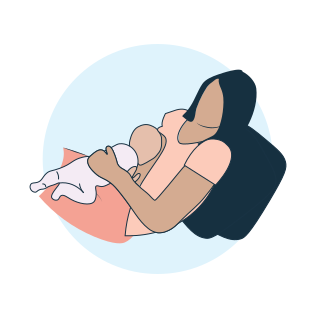
    Laid-Back Hold

    1. Lean back on a pillow with your baby’s tummy touching yours and their head at breast level. Some moms find that sitting up nearly straight works well. Others prefer to lean back and lie almost flat.
    2. You can place your baby’s cheek near your breast, or you may want to use one hand to hold your breast near your baby. It’s up to you and what you think feels best.
    3. Your baby will naturally find your nipple, latch, and begin to suckle.

    This hold is useful when:

    • Your baby is placed on your chest right after birth
    • You have a strong milk let-down
    • You have large breasts
    • You and your baby are comfortable in this position